

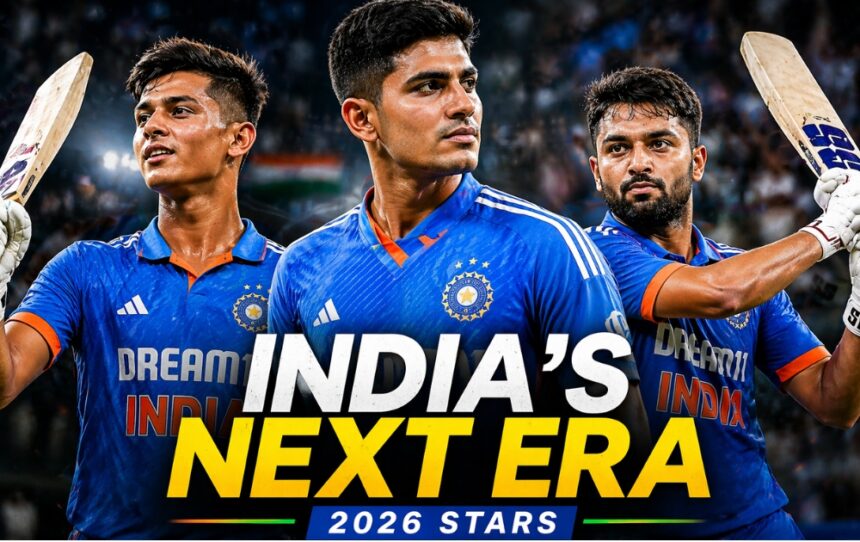

Indian cricket is entering a major transition period. With veterans like Virat Kohli and Rohit Sharma approaching the final phase of their international careers, India’s next generation is already becoming the backbone of the national setup.
What makes this generation different is not just talent — it is preparation.
Unlike previous eras where young players slowly adjusted to international pressure, modern Indian cricketers now arrive with:
- IPL experience against world-class players
- advanced fitness standards
- tactical awareness
- pressure-game exposure
After IPL 2025, several young Indian players strengthened their long-term claims for leadership roles across formats. From Shubman Gill’s consistency to Yashasvi Jaiswal’s explosive scoring and Rinku Singh’s finishing ability, India’s next core already looks stronger than most international teams.
This ranking is based on:
- IPL 2025 performances
- International form
- Match-winning impact
- Statistical consistency
- Long-term potential
- Tactical value across formats
Performance references and statistical trends are based on IPL and ICC records available through 2025.
Quick Comparison Table – Best Young Indian Cricketers in 2026
| Player | Age | IPL Team | Primary Role | Key Strength |
|---|---|---|---|---|
| Shubman Gill | 26 | Gujarat Titans | Top-order batter | Multi-format consistency |
| Yashasvi Jaiswal | 24 | Rajasthan Royals | Aggressive opener | Fast scoring |
| Ruturaj Gaikwad | 29 | Chennai Super Kings | Opening batter | Stability |
| Tilak Varma | 23 | Mumbai Indians | Middle-order batter | Spin control |
| Rinku Singh | 28 | Kolkata Knight Riders | Finisher | Death-over batting |
| Arshdeep Singh | 27 | Punjab Kings | Left-arm pacer | Yorker execution |
| Umran Malik | 26 | Sunrisers Hyderabad | Fast bowler | Extreme pace |
| Ravi Bishnoi | 26 | Lucknow Super Giants | Leg-spinner | Middle-over wickets |
| Ishan Kishan | 28 | Sunrisers Hyderabad | Wicketkeeper-batter | Explosive starts |
| Washington Sundar | 27 | Gujarat Titans | All-rounder | Tactical balance |
How These Rankings Were Calculated
Players were evaluated using:
- IPL 2025 performances
- International match impact
- Batting and bowling consistency
- Role difficulty
- Pressure performances
- Tactical versatility
- Long-term value between 2026–2030
This list focuses on players expected to remain important to Indian cricket for several years rather than short-term form alone.
Why India’s New Generation Looks Different
The IPL has completely transformed Indian cricket’s development system.
Young players now enter international cricket after facing:
- elite fast bowlers
- high-pressure chases
- global tactical environments
- massive crowds and media attention
This has accelerated development dramatically.
India’s new generation is:
- more aggressive
- tactically smarter
- fitter athletically
- more adaptable across formats
The result is a player pool that looks significantly more prepared than previous generations.
1. Shubman Gill – India’s Future All-Format Leader
Shubman Gill has emerged as the most complete young batter in Indian cricket.
His balance between:
- technical control
- shot selection
- strike rotation
- modern attacking cricket
makes him effective in every format.
Gill’s ODI consistency since 2023 has placed him among the world’s highest-performing young top-order batters.
IPL & International Snapshot (2025)
| Metric | Performance |
|---|---|
| ODI Average | 52 |
| IPL Role | Captain and opener |
| IPL 2025 Runs | 612 |
| Primary Strength | Pace batting |
| India Role | Future all-format leader |
Why Gill Stands Above Most Young Players
Gill’s biggest advantage is adaptability.
Unlike players who succeed only in one format, Gill has already shown he can:
- anchor ODI innings
- build Test innings
- accelerate in T20 cricket
His off-side strokeplay against fast bowling remains among the cleanest in modern Indian cricket.
Real Match Impact
Gill’s ODI centuries against major international teams established him as India’s long-term top-order anchor after the Kohli era.
Main Weakness
His T20 powerplay tempo occasionally starts too cautiously.
2. Yashasvi Jaiswal – India’s Most Explosive Young Batter
Yashasvi Jaiswal has become one of the fastest-rising young cricketers in world cricket.
His aggressive approach against:
- pace
- spin
- short bowling
makes him dangerous immediately after arriving at the crease.
IPL & International Snapshot (2025)
| Metric | Performance |
|---|---|
| IPL Strike Rate | 154 |
| IPL 2025 Runs | 510 |
| Best Formats | Tests + T20 |
| Primary Role | Aggressive opener |
| Boundary Percentage | Among highest for Indian openers |
Why Jaiswal Is Different
Few young Indian batters combine:
- entertainment value
- pressure handling
- multi-format success
- attacking consistency
as effectively as Jaiswal.
Real Match Impact
His attacking Test hundreds against England accelerated his rise as one of India’s future all-format stars.
Main Weakness
Aggressive shot selection can still create unnecessary dismissals.
3. Ruturaj Gaikwad – India’s Most Reliable Young Run Accumulator
Ruturaj Gaikwad continues to be one of India’s most technically stable young batters.
Unlike ultra-aggressive T20 hitters, Gaikwad succeeds through:
- timing
- positioning
- strike rotation
- controlled acceleration
IPL & International Snapshot (2025)
| Metric | Performance |
|---|---|
| IPL Seasons Above 500 Runs | 4 |
| IPL Strike Rate | 144 |
| Main Role | Opener |
| Strongest Quality | Consistency |
Why Teams Value Gaikwad
Modern T20 cricket still requires stability at the top. Gaikwad’s ability to absorb pressure without collapsing scoring tempo makes him valuable in difficult conditions.
Main Weakness
Late-innings acceleration remains inconsistent.
4. Tilak Varma – India’s Middle-Order Fix
Tilak Varma has emerged as one of India’s most promising middle-order batters.
His value comes from flexibility.
He can:
- rebuild innings
- rotate strike
- attack spin
- accelerate late
depending on match situations.
IPL & International Snapshot (2025)
| Metric | Performance |
|---|---|
| Strike Rate Range | 135–145 |
| Preferred Role | Middle order |
| Strongest Skill | Spin batting |
| Tactical Value | Flexible batting tempo |
Real Match Impact
Tilak’s performances for Mumbai Indians under pressure established him as a future middle-order solution for India.
Main Weakness
Needs more defining innings against elite international attacks.
5. Rinku Singh – India’s Best Young Finisher
Rinku Singh has become one of India’s most dependable white-ball finishers.
His biggest strength is decision-making during high-pressure chases.
IPL & International Snapshot (2025)
| Metric | Performance |
|---|---|
| Death Overs Strike Rate | 168 |
| Main Role | Finisher |
| IPL Team | Kolkata Knight Riders |
| Key Strength | Chase finishing |
Why Rinku Is Special
Finishing remains one of cricket’s rarest skills.
Rinku’s calmness during death overs separates him from many young power hitters who rely purely on aggression.
Real Match Impact
His match-winning finishing performances in IPL pressure chases transformed him from a domestic player into a national-level T20 asset.
Main Weakness
Still building a larger international sample size.
6. Arshdeep Singh – India’s Most Reliable Young Death Bowler
Arshdeep Singh has quietly become one of India’s most trusted white-ball pacers.
His effectiveness comes from:
- yorkers
- slower balls
- left-arm angle variation
- composure under pressure
IPL & International Snapshot (2025)
| Metric | Performance |
|---|---|
| Economy in Death Overs | Among India’s best |
| Bowling Role | Death overs specialist |
| Main Weapon | Yorkers |
| White-Ball Role | Strike pacer |
Real Match Impact
Arshdeep’s ICC tournament performances strengthened his reputation as one of India’s safest late-overs bowling options.
Main Weakness
Can become expensive on flat batting surfaces.
7. Umran Malik – India’s Fastest Bowling Prospect
Umran Malik remains one of the fastest bowlers India has produced.
Consistently crossing 150 km/h, he offers something historically rare in Indian cricket: genuine express pace.
IPL & International Snapshot (2025)
| Metric | Performance |
|---|---|
| Average Pace | 151.2 km/h |
| Main Strength | Raw speed |
| Bowling Style | Express pace |
| Major Challenge | Accuracy |
Why Selectors Still Back Him
Even when inconsistent, Umran’s pace changes batting behavior immediately.
India has historically lacked bowlers capable of consistently producing extreme pace.
Main Weakness
Control and economy rate remain inconsistent.
8. Ravi Bishnoi – India’s Smartest Young Spinner
Ravi Bishnoi’s tactical awareness makes him one of India’s most intelligent young T20 bowlers.
He excels at:
- variation usage
- middle-over pressure
- matchup bowling
- partnership breaking
IPL & International Snapshot (2025)
| Metric | Performance |
|---|---|
| Bowling Type | Leg-spin |
| Strongest Format | T20 |
| Main Role | Middle-over wicket taker |
| Key Skill | Variations |
Real Match Impact
Bishnoi’s ability to break partnerships during middle overs has made him increasingly valuable in modern T20 cricket.
Main Weakness
Needs stronger performances in longer formats.
9. Ishan Kishan – India’s Momentum Player
Ishan Kishan remains one of India’s most explosive wicketkeeper-batters.
His ability to dominate powerplays rapidly shifts match momentum.
IPL & International Snapshot (2025)
| Metric | Performance |
|---|---|
| Strike Rate | 143 |
| Main Role | Wicketkeeper-opener |
| Batting Style | Aggressive |
| Biggest Advantage | Fast starts |
Real Match Impact
Kishan’s aggressive ODI double century and IPL powerplay performances demonstrated how quickly he can alter games.
Main Weakness
Shot selection consistency remains an issue.
10. Washington Sundar – India’s Tactical Balance Specialist
Washington Sundar provides value beyond traditional statistics.
His combination of:
- economical bowling
- batting depth
- flexibility
makes him useful across multiple conditions and formats.
IPL & International Snapshot (2025)
| Metric | Performance |
|---|---|
| Role | All-rounder |
| Bowling Strength | Powerplay economy |
| Batting Role | Lower-middle order |
| Biggest Value | Team balance |
Real Match Impact
Sundar’s ability to contribute in both batting and bowling gives captains tactical flexibility during team selection.
Main Weakness
Injuries have interrupted momentum repeatedly.
Emerging Indian Cricketers Who Could Break Out Next
Several additional young Indian players are pushing toward long-term national roles.
Rising Talents To Watch
- Mayank Yadav
- Harshit Rana
- Sai Sudharsan
- Nitish Kumar Reddy
- Dhruv Jurel
- Abhishek Sharma
Several IPL scouts and analysts consider this group among the strongest Indian talent waves since the early Kohli-Rohit generation.
Young Players Who Narrowly Missed The Top 10
A few talented players narrowly missed this list because of limited international sample sizes or inconsistency.
Honourable Mentions
- Rajat Patidar
- Rajvardhan Hangargekar
- Prabhsimran Singh
- Nehal Wadhera
How IPL Changed Indian Cricket Development Forever
The IPL permanently changed Indian cricket’s talent system.
Biggest IPL Advantages
- earlier exposure to elite pressure
- tactical learning from international players
- financial stability
- faster white-ball development
- accelerated confidence building
Young Indian cricketers now enter international cricket significantly more prepared than previous generations.
Future India XI Prediction (2030)
| Position | Player |
|---|---|
| Opener | Yashasvi Jaiswal |
| Opener | Shubman Gill |
| No. 3 | Tilak Varma |
| Finisher | Rinku Singh |
| All-rounder | Washington Sundar |
| Spinner | Ravi Bishnoi |
| Pacer | Arshdeep Singh |
Several of these players are already expected to become long-term pillars of India’s future white-ball structure.
Biggest Challenges This Generation Still Faces
Despite the talent level, several challenges remain:
- injury management
- social media pressure
- schedule overload
- maintaining consistency
- adapting across formats
The transition from IPL success to sustained international greatness remains one of cricket’s biggest challenges.
Frequently Asked Questions
Q1. Who is the best young Indian cricketer in 2026?
Shubman Gill is currently considered India’s most complete young batter across formats because of his consistency, adaptability, and leadership potential in international cricket.
Q2. Which young Indian batter has the highest superstar potential?
Yashasvi Jaiswal is widely viewed as one of India’s biggest future stars because of his aggressive batting style, fearless approach, and strong multi-format potential.
Q3. Who is India’s best young finisher?
Rinku Singh has emerged as one of India’s most dependable young finishers thanks to his calmness during pressure chases and excellent death-over batting.
Q4. Which Indian youngster bowls the fastest?
Umran Malik remains India’s quickest emerging fast bowler, regularly crossing 150 km/h with genuine express pace.
Q5. Which young player could become India’s next captain?
Shubman Gill currently appears the strongest long-term leadership candidate because of his composure, consistency, and growing captaincy experience in the IPL and international cricket
Sources & Statistical References
Performance trends and statistics referenced in this article are based on:
- IPL records through 2025
- ICC international cricket records
- publicly available match statistics
- player performance trends across IPL and international formats
For updated official statistics, readers can refer to:
Final Thoughts
Indian cricket’s next generation is no longer a future projection — it is already reshaping the national team structure.
Backed by IPL experience, tactical maturity, and stronger athletic standards, this young core looks more prepared for international cricket than most previous Indian generations.
If these players continue developing consistently, India could maintain one of the strongest long-term talent pipelines in world cricket through the remainder of the decade.
Author: Aman Sharma
Aman Sharma is a sports finance writer specializing in IPL salaries, cricketer net worth, endorsement deals, and Indian cricket business analysis. His coverage focuses on player earnings, franchise contracts, sponsorship growth, and cricket industry trends.